Guide 1 of 5 · 6 min read
Your DNA is a set of instructions you carry in almost every cell. A wellness DNA test reads a small, chosen part of it to understand some of your tendencies. Here's how that works, without the jargon.
DNA: your body's instruction book
DNA is the molecule that carries the instructions for building and running your body. You inherit it from your parents, half from each, and the same copy sits inside nearly every cell you have.
Those instructions are written in a very small alphabet of just four chemical "letters", usually shortened to A, T, C and G. Your full set contains roughly three billion pairs of these letters.
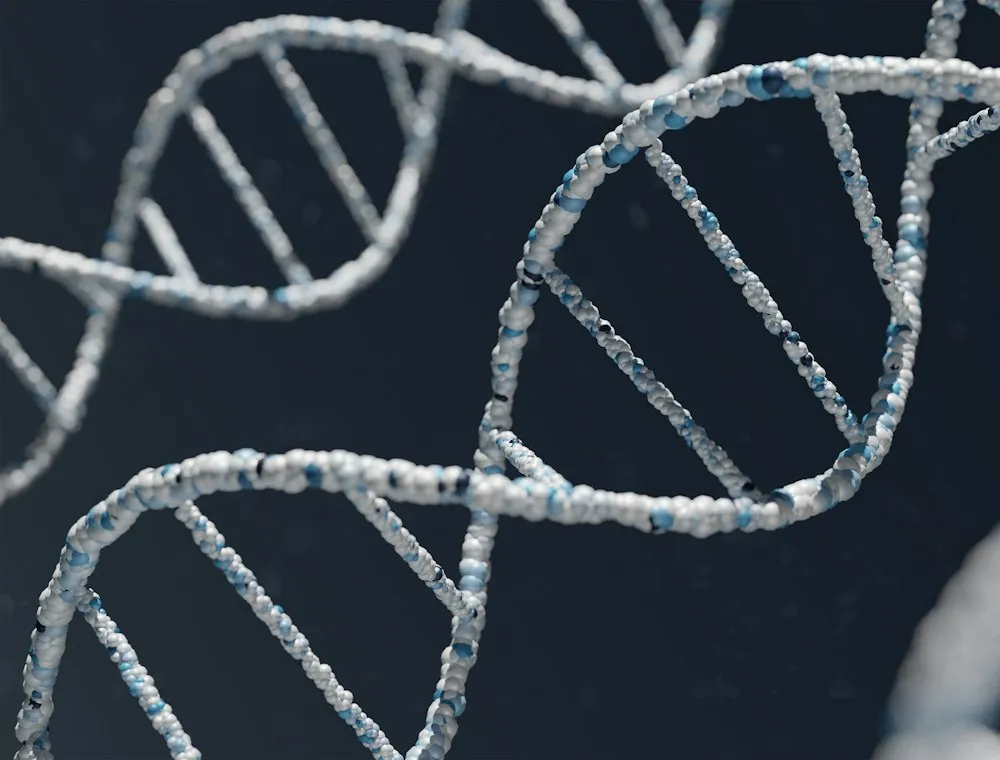
DNA is shaped like a twisted ladder, the famous double helix. The letters form the rungs, always pairing the same way: A with T, and C with G. That pairing is what lets DNA copy itself accurately every time a cell divides.
Genes: the words that do the work
A gene is a section of DNA that tells your cells how to make something, usually a protein. Proteins do most of the work in your body: digesting food, carrying oxygen, building muscle, sending signals. Humans have somewhere around twenty thousand genes.
The tiny differences that make you, you
Any two people share about 99.9% of their DNA. The remaining sliver is what makes us different, and a lot of it comes down to single-letter changes at particular spots. Scientists call these SNPs (single nucleotide polymorphisms, pronounced "snips").
Think of changing one letter in a word: "bat" becomes "cat". The word still works, but it means something slightly different. Many SNPs are harmless and do nothing noticeable. Some are linked to small differences in how our bodies handle things like certain nutrients, caffeine or exercise.
Your DNA doesn't change. The variations a wellness test looks at stay the same throughout your life, which is why you only need to test once.
What a wellness DNA test actually does
A wellness DNA test doesn't read your whole genome. It looks at a chosen panel of variations that research has linked to everyday traits, such as how you tend to respond to certain foods, nutrients and activity. The steps are simple:
- You collect a small saliva sample at home.
- A laboratory extracts DNA from the cells in your saliva.
- The lab checks the variations covered by your test.
- The results are compiled into a report, which the AURA team explains with you.
What it can't tell you
This is just as important. A wellness DNA test:
- is not a diagnosis. It can't tell you whether you have, or will get, a disease.
- shows tendencies, not certainties. Genes are one influence among many; food, sleep, activity, stress and environment matter just as much.
- doesn't replace your doctor, blood tests or medical advice.
That's why AURA never hands you a report on its own. The value comes from understanding what your tendencies mean for your daily life, and getting support to act on them.
Want to know what your own DNA says?
Start with a free guidance session to find the right test for your goals.
Book a guidance session